
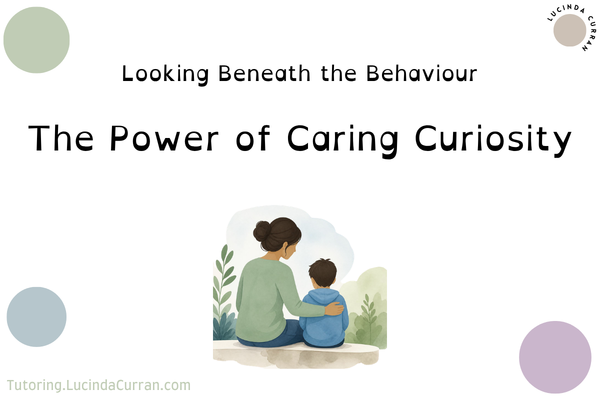
Looking Beneath the Behaviour: The Power of Caring Curiosity
Looking beneath the behaviour doesn’t mean becoming a detective who needs to discover the hidden reason behind everything a child does.
It means noticing.
A child who is usually chatty becomes quiet. A teenager begins withdrawing. Someone who normally joins in starts avoiding things. A familiar pattern changes.
We might not know why.
But something in us notices: Something isn’t quite right.
That is where I think caring curiosity begins.
Caring curiosity is more than curiosity
Curiosity on its own asks questions.
Caring curiosity begins with care.
We notice because we know this child.
It is due to this that we can sense a change.
We pay attention.
We move towards them with kindness rather than judgement.
Perhaps we –
- Ask, “Are you okay?”
- Sit beside them
- Offer a hug, if that’s welcome
- Communicate: “I’m here. I love you. I care.”
The response might be a shrug.
“I’m fine.”
Nothing.
Or perhaps the metaphorical door remains firmly bolted.
That doesn’t mean our caring has failed.
Give space, but don’t disappear
There is a difference between giving someone space and leaving them alone.
Sometimes space is exactly what a child needs.
The important part is remaining visibly, consistently caring.
And importantly, not lurking.
We don’t need to hover nearby waiting for the moment they finally talk.
We can get on with ordinary life.
We can make them a cup of tea.
Leave a favourite book nearby.
Put on some music.
Offer something to eat.
Sit in the same room.
Go for a walk together another day.
Send a little message.
Keep being their parent.
If the child isn’t ready to talk, we can say: “I’m here. I love you. I care. You can tell me when you’re ready.”
Then we can step back without stepping away.
Not pestering isn’t the same as giving up.
Safety can become an invitation
Sometimes we imagine that if we ask the right question, a child will tell us what is wrong.
It doesn’t always work that way.
When someone is struggling, admitting that they are struggling can be difficult.
It could be that they don’t want to worry us.
Perhaps they feel embarrassed.
Maybe they don’t understand their own experience yet.
They may have become very good at managing things privately.
Or perhaps they simply don’t have the words.
This last possibility matters enormously.
Not having the words can be part of the problem.
If we keep asking for a verbal explanation from someone who cannot yet find one, we may unintentionally make communication harder.
Safety offers another possibility.
When a child experiences an adult as calm, caring and available, without being pressured to produce an explanation, they may gradually discover that it is safe to communicate.
Sometimes the door opens.
Sometimes it doesn’t.
Our job isn’t to force it.
Communication doesn’t always arrive as words
If words aren’t available, there are other ways to communicate.
Some ideas are:
- Drawing
- Painting
- Building with playdough or modelling clay
- Making music
- Writing
- Playing
- Telling a story that appears to have nothing whatsoever to do with them.
We can sometimes create a parallel activity, where we’re doing something alongside one another rather than sitting face-to-face demanding conversation.
Hands can be busy.
Eyes can look elsewhere.
The pressure can soften.
And sometimes, while we’re making something together, words arrive.
Perhaps only one sentence.
It could be a fragment.
Maybe a completely sideways story.
We can listen.
Sometimes a puppet makes the conversation easier
With younger children, I’ve found puppets can be particularly useful.
The important bit is surprisingly simple: Talk to the puppet, not directly to the child.
When the adult looks at the puppet rather than watching the child’s face, some of the pressure disappears.
You could ask the puppet a question.
The puppet can answer.
They can correct the puppet.
The puppet might express what they really think.
Or the puppet can simply become a little intermediary between the child and the adult.
It isn’t really about the puppet.
It’s about changing the conditions around communication.
Sometimes reducing the intensity of “Look at me and tell me what’s wrong” creates enough safety for something else to emerge.
Looking beneath the behaviour doesn’t mean deciding what it means
This matters.
A child pushes something away.
We might think: They’re refusing.
A child becomes noisy.
We might think: They’re being disruptive.
A teenager withdraws.
We might think: They’re being difficult.
But behaviour doesn’t come with subtitles.
We can notice what we observe without automatically deciding what it means.
They could be tired or overwhelmed.
Maybe something happened earlier.
Perhaps the task is too difficult.
It’s possible that they don’t understand what is expected.
They may be completely distracted be something unrelated – and that is all that is occupying their mind.
Perhaps none of those things.
We don’t know yet.
Caring curiosity allows us to remain open to that uncertainty.
Play can tell us things too
For educators especially, observing children in play can sometimes reveal aspects of their experience that don’t emerge in direct conversation.
A child might turn a collection of dolls into an elaborate drama.
- The characters could be fighting
- Perhaps one is always excluded
- Maybe someone is frightened, rescued, controlled or abandoned
- Or the whole thing becomes an unexpected Punch-and-Judy performance
We might notice.
We might wonder.
But we don’t need to immediately announce: “This must mean something terrible happened.”
Play can be:
- Imagination
- Experimentation
- A reflection of something a child has seen
- A way of exploring emotions or relationships
- Absolutely nothing more than a really interesting story
So again: Notice without deciding.
For an educator, sustained patterns may be worth paying attention to. A significant change in a child’s behaviour or play may provide a reason to check in, communicate with relevant adults or seek appropriate support.
But we don’t need to become amateur psychologists, decoding every game a child invents.
We’re simply paying attention to the person.
Teenagers may communicate through silence
This becomes particularly important as children grow older.
A teenager may not want to sit down and tell us what is happening.
They may communicate through changes instead.
Less conversation.
More time alone.
Different patterns of participation.
Irritability.
Avoidance.
A loss of interest in things they usually enjoy.
Or simply a sense that something has shifted.
None of these automatically means that something is wrong.
But when we know someone well, changes in their usual patterns can be worth noticing.
Caring curiosity doesn’t demand an explanation.
It says:
I see that something has changed.
I’m still here.
You don’t have to tell me everything right now.
And you don’t have to carry it completely alone.
The door may stay bolted
Sometimes we do everything gently and thoughtfully, and the door still doesn’t open.
That’s okay.
We can continue to offer care without making the child responsible for reassuring us.
Perhaps today there is a cup of tea.
Tomorrow there is a shared walk.
Another day there is music.
Maybe we sit together and watch something.
Maybe we leave a book beside them.
Maybe the puppet makes another appearance.
There is no guarantee that any particular approach will unlock communication.
But consistent care communicates something important even when words don’t.
The message is simple:
I’m here. I love you. I care. You can tell me when you’re ready.
And perhaps, over time, the safety created by that consistency becomes an invitation.
Not a demand.
An invitation.
May you also be interested in:
If you’re interested in the ways children communicate, learn and make sense of experiences that aren’t always visible to adults, you might also enjoy How Children Make Sense of the World: The Connections We Don’t Always See.